
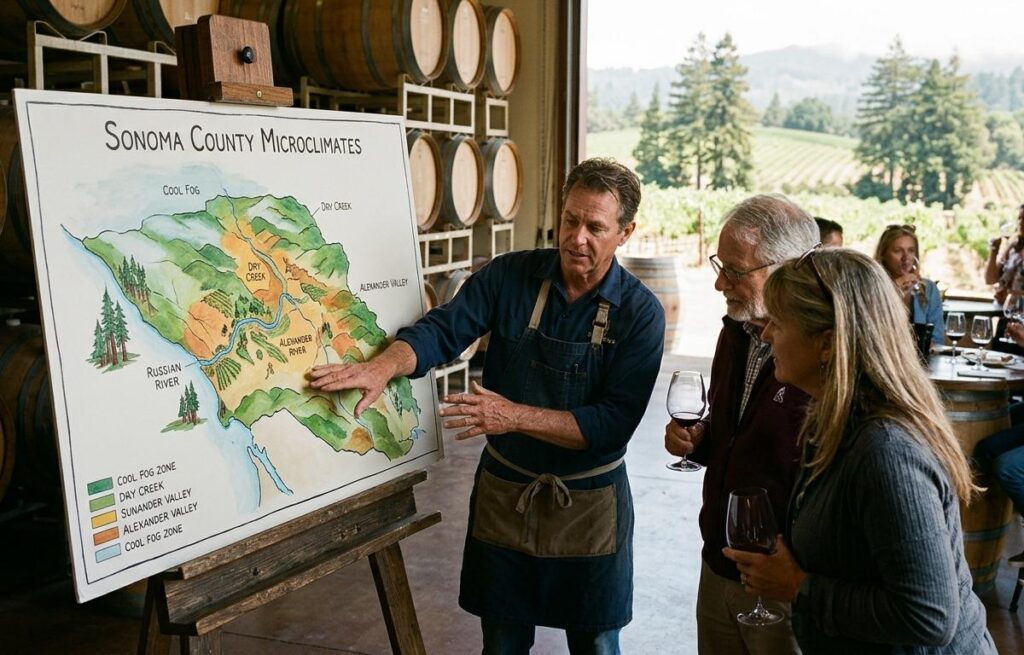
How Sonoma’s Microclimates Work: Fog, Heat and Ocean Air
Here’s something locals know that visitors usually figure out on their second glass: Sonoma County isn’t one climate. It’s a patchwork. You can leave a foggy, jacket-weather tasting room in the morning and be sweating in a sun-baked valley by lunch, all without leaving the county. That’s what a sonoma county microclimates map really shows you: a handful of simple forces, shoved around by hills, rivers and gaps in the coastal mountains.
Three things drive it all: ocean air, fog and heat. The Pacific is cold, and it sends cool, moist air inland through whatever opening it can find. When the inland valleys bake in the afternoon, the hot air rises and pulls that marine air in like a vacuum. The fog rolls in overnight, blankets the low spots, and burns off mid-morning. How far it travels, and how long it hangs around, decides almost everything about what grows well where.
Geography handles the rest. Mountain ranges block the ocean air in some places and funnel it in others. A river valley can work like a conveyor belt for fog. A ridge can wall off a whole valley and leave it warm and dry. The county has almost 60,000 acres of vineyards and more than 425 wineries spread across 19 AVAs, per Sonoma County Tourism, and those boundaries exist because the climate shifts so much from one pocket to the next. (That count of 19 comes from the county tourism board, so if you see a different number elsewhere, that’s why.)
The payoff is a big swing between day and night in many areas. Warm afternoons ripen the fruit, then cool nights hold onto acidity and keep the flavors lively. It’s why so many different grapes thrive here, and why a tasting room twenty minutes down the road can pour something that tastes like it came from another country.
Mapping the Key Zones: Petaluma Gap, Russian River, Dry Creek and Beyond
Picture the county as a rough diagonal: cool and foggy toward the coast and the southern bay, warmer as you head inland and north. Let’s walk the key zones, starting at the cool end.
Petaluma Gap. Recognized as an AVA in 2017 and sitting about 25 miles north of San Francisco, this one is all about wind and fog funneling in from San Pablo Bay, according to the sonoma.com AVA guide. The day-to-night temperature swings are big. Think breezy, cool, a little rugged.
Russian River Valley. Cool by nature and heavily shaped by fog from the nearby Pacific, as the Russian River Valley AVA page notes. That fog is the signature of the whole area, and you’ll feel it in the morning chill before the sun takes over.
Carneros. Down at the southern edge by the bay, it earned its spot in the history books as the first California wine region defined by climate rather than political boundaries, per sonoma.com. It’s a good example of why the map is drawn the way it is.
Sonoma Valley. Here’s a neat twist. The Sonoma Mountains block Petaluma’s heavy fog from most of the valley, which makes it the driest area in the county, according to the Sonoma Valley AVA entry. Same county, very different feel.
Dry Creek Valley. About 16 miles long and two miles wide, tucked west of Healdsburg and Geyserville and shielded from the ocean by high coastal mountains, per the Capstone California study guide. It’s a compact, sheltered little slice.
Alexander Valley. It gets quite hot during the day, but Russian River fog cools it considerably at night (sonoma.com). Warm afternoons, cool evenings, and a very comfortable place to be around sunset.
Rockpile. Discover California Wines calls it the hottest AVA in the county. It’s remote and rugged and not on most casual itineraries, but it anchors the hot end of the map.
One honest caveat: I can’t hand you a labeled graphic here, and I won’t pretend to pin down exact fog timing by month. Treat this as the mental map. Cool and foggy toward the coast and bay, sheltered and warm in the interior valleys, hot at the far edges.
What Each Microclimate Means in the Glass
This is where the geography gets fun, because you can taste it. The rule of thumb is simple: cooler places tend to make wines with more brightness and tension, and warmer places tend to make riper, fuller ones. Here’s how that plays out in what’s pouring.
Cool, fog-influenced areas like the Russian River Valley are known for Pinot Noir and Chardonnay. Those grapes like a long, gentle ripening season, and the fog gives them exactly that. In the glass, expect more freshness and a lighter touch. Sonoma County’s biggest plantings tell the same story: Chardonnay and Pinot Noir lead in acreage, followed by Cabernet Sauvignon, Zinfandel and Merlot, according to county wine facts.
Move inland to the warmer, sheltered valleys and the personality shifts. Dry Creek Valley has a reputation for some of America’s best Zinfandel, and it’s home to some of the oldest continually producing vineyards in California. Alexander Valley, with those hot days and cool nights, is known for structured yet elegant Cabernet Sauvignon. That warm-then-cool rhythm lets the grapes get ripe without losing their backbone.
Wind matters too. In the Petaluma Gap, the steady breeze and cool air tend to thicken grape skins and slow ripening, which is part of why the area’s wines get talked about for their vivid, savory character.
A gentle reality check from your friendly local: these are tendencies, not rules. A winemaker’s choices, the slope of a vineyard, even a single block’s soil can nudge a wine one way or the other. Use the map as a guide to what’s likely, then let your own palate overrule it. If you want the bigger picture of how Sonoma stacks up against its neighbor, our rundown on the best wine region, Sonoma or Napa digs into style differences.
Planning Your Day Around the Map: Which Tasting Rooms, and When
Now for the part nobody else seems to tell you: how to turn all this into a day that works. The big idea is to match your plan to the climate instead of fighting it.
Mind the heat. Hot interior spots like Alexander Valley are most comfortable in the morning and again toward evening. Visiting in summer? Book your warmest-area tasting early or save it for late in the day, and tuck cooler stops into the middle. Fog-cooled areas make a smart afternoon refuge when the interior is toasty.
Pack layers. If you take one tip from this page, make it this one. A morning in a fog-influenced valley can feel chilly, and an afternoon a few miles inland can feel like another planet. A light jacket you can stuff in a bag solves nearly everything. Don’t trust the weather at your hotel to tell you what the next valley feels like.
Cluster by zone. Sonoma County is big, and the distance between areas adds up fast. Rather than ping-ponging between the coast and the northern valleys, group your stops. A Dry Creek and Alexander Valley day pairs naturally around Healdsburg. A Sonoma Valley day keeps you in the drier, sunnier heart of the county. If you’re based near Santa Rosa, our guide to a Sonoma wine tour near Santa Rosa helps you sort out what’s close and what’s a stretch.
Match the grape to your mood. Want crisp, cool-climate wines? Aim for the fog-kissed zones. Craving a bigger, riper red? Head for the warmer valleys. If you’d like to explore past the usual stops, our take on laid back Sonoma wine trips off the beaten path points to the quieter corners.
One more note: most visitor sources now say reservations are strongly recommended at many wineries, especially on weekends and in summer, so lock in your times before you go instead of winging it. And since last tastings often start about half an hour before closing, don’t cut it too close.
Booking Tastings and Getting Around Without the Stress
Here’s the honest part. A sonoma county microclimates map is a beautiful thing until you realize that following it means driving between zones, tasting at each one, and then driving again. Sonoma is roughly twice the size of Napa, and visitor sources consistently say it takes more planning and drive time between destinations. That’s a lot of winding road to handle with a glass or three in you.
That’s exactly why a lot of folks hand over the keys. With a driver, the geography stops being a logistics puzzle and becomes the whole point. You can cross from a foggy Pinot stop to a sunny Cab room without watching the clock, a map or the pour size. Rideshare is an option, but pickups in rural wine country can run long, and you don’t want to be stuck at a tasting room gate at closing time.
A custom tour is where the microclimate idea really shines. Tell us whether you want cool-climate whites and Pinot, warm-valley Zin and Cab, or a mix of both, and we’ll build a route that makes sense on the ground, with the right stops in the right order for the weather. We also juggle the reservations, which is half the battle on a busy weekend. For a feel of what’s possible, take a look at our locals’ napa sonoma wine tours off the map, or browse the full services page to see how small groups, bachelorette parties and custom days come together.
Still deciding where to start? Wine tasting tours near me breaks down costs and picks in plain terms. Either way, let the fog and the sunshine do the planning. Your only job is to bring a jacket and an appetite, and maybe a designated sipper who doesn’t have to be the driver.